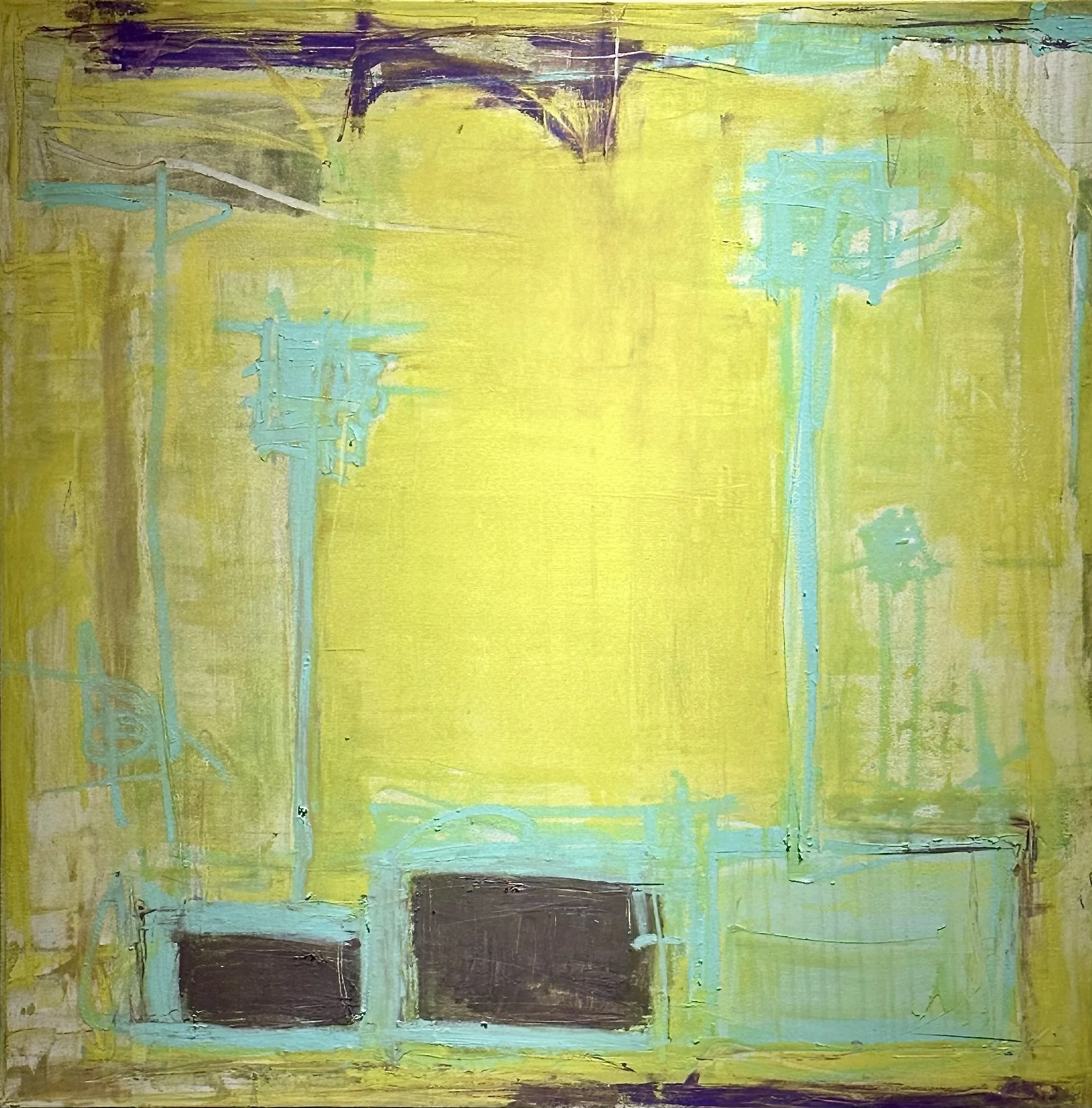
Acid Satellite presents a compact yet expansive field of color that commands measured attention. A dominant acid yellow ground establishes a luminant, near-auroral atmosphere across the square format. Against this radiant plane, gestures of violet and blue-green punctuate and orbit the composition, their cooler tones negotiating tension and balance with the luminous warmth beneath. The application of oil and wax produces a surface that is both sensuous and restrained: layers melt into one another at some points, while elsewhere they remain deliberately distinct, offering a range of textures from soft bloom to taut edge.
Formally spare but compositionally deliberate, the painting evokes the geometry and ephemeral light of an urban landscape. The acid yellow reads like an urban glow—neon, sodium streetlamp, reflected signage—while the violet and blue-green accents act as structural inflections, suggesting shadows, architectural silhouettes, and the stray fluorescence of a city at dusk. These elements do not illustrate a specific skyline; rather, they index the sensation of being within a city’s luminous field, moving through pockets of color and shadow that shift with perspective and time.
Acid Satellite is contemplative in its restraint. The visual economy and the painting’s subtle surface complexity invite extended viewing: minute transitions in hue and the interplay of material qualities reveal themselves slowly, rewarding prolonged attention. The work functions as an evocative proposition more than a resolved narrative, encouraging the viewer to inhabit its chromatic tensions and to construct personal
Acid Satellite presents a compact yet expansive field of color that commands measured attention. A dominant acid yellow ground establishes a luminant, near-auroral atmosphere across the square format. Against this radiant plane, gestures of violet and blue-green punctuate and orbit the composition, their cooler tones negotiating tension and balance with the luminous warmth beneath. The application of oil and wax produces a surface that is both sensuous and restrained: layers melt into one another at some points, while elsewhere they remain deliberately distinct, offering a range of textures from soft bloom to taut edge.
Formally spare but compositionally deliberate, the painting evokes the geometry and ephemeral light of an urban landscape. The acid yellow reads like an urban glow—neon, sodium streetlamp, reflected signage—while the violet and blue-green accents act as structural inflections, suggesting shadows, architectural silhouettes, and the stray fluorescence of a city at dusk. These elements do not illustrate a specific skyline; rather, they index the sensation of being within a city’s luminous field, moving through pockets of color and shadow that shift with perspective and time.
Acid Satellite is contemplative in its restraint. The visual economy and the painting’s subtle surface complexity invite extended viewing: minute transitions in hue and the interplay of material qualities reveal themselves slowly, rewarding prolonged attention. The work functions as an evocative proposition more than a resolved narrative, encouraging the viewer to inhabit its chromatic tensions and to construct personal